Thursday, August 30, 2012
Tuesday, August 28, 2012
Valley Homes in Pictures and Kathmandu's Housing Bubble
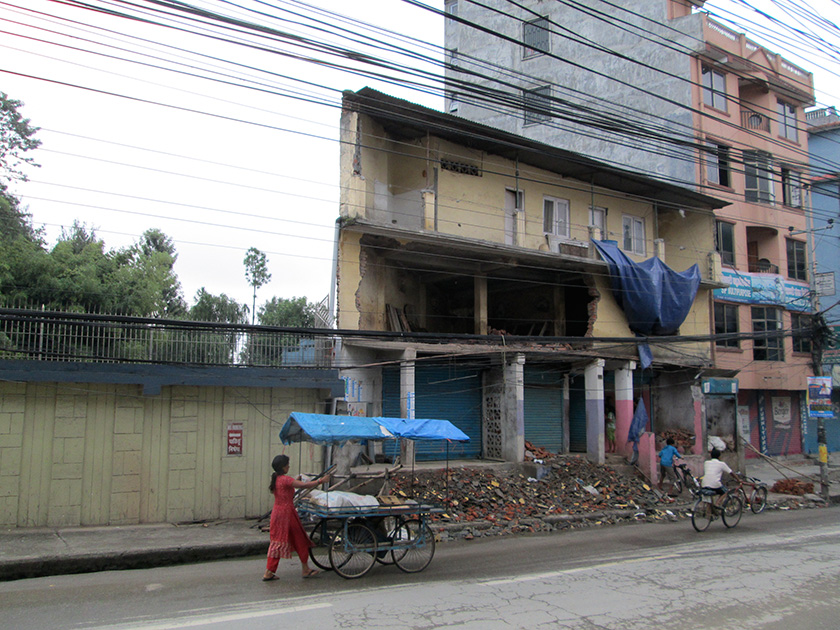
The other day I spent few hours photographing at Terraces, property owned by Valley Homes in Sunakothi. My deepest gratitude to Dr. Maya Battachan and Dr. Saroj Baidya for arranging my access to the housing colony. Terraces is smaller in size compared to Civil
Homes, but catered for higher end market (see my earlier blog entry on Kathmandu's Housing Colony Experience).
![]() |
| View from Dr. Baidya's rooftop |
![]() |
| Unfinished property in Terraces |
Bal Krishna Joshi on Kathmandu's Housing Bubble
I recently met my friend Bal Krishna Joshi, who is an innovative and an successful young entrepreneur based in Kathmandu. Thamel.com is his primary business, which caters to Nepalese in the diasporas. Below you will find an excerpt as he explains to me Kathmandu's failing housing economy, over lunch.
![]() |
| Bal K Joshi |
More than 40% of the Nepal's GDP is sustained by
remittance. That’s a shit load of freaking money. If you look at the official
numbers, they say it is 20%. But another 20% is coming through the informal channels. So 40% of the total GDP, which amounts to little bit over to
four billion dollars per year is coming to this country as remittance. And
there is not productive use of it. One sector of the remittance directly goes into
daal bhat tarkari (typical Nepali staple of rice lentils and curry, in other
words for feeding families). These are generally people who have gone abroad
from the villages. But more than 40% of the incoming money is going into real
estate. One is, we have a cultural stigma of buying a house and buying property.
And also during the insurgency (Maoist),
everything but Kathmandu was not safe to live. So people started migrating
here. There are two interesting shifts in this migration. In that migration,
the early adopters were the people with money from the villages. These are the
people who had houses and businesses outside of Kathmandu. But they wanted to
something easy to manage, like apartments (condominiums). Once these people came
from outside came, it became a very exaggerated economy. Believe it or not in
this place (Durbar Marg) the market price for one anna (1 anna = 342.42 sq. feet, 16 annas = 1 ropani = 5,476
sq. feet) is Rs, 10 Karod (approximately US $ 1,130,000). It
is not sustainable economy. It is completely exaggerated. That means
it’s more expensive than freaking Manhattan. Doesn’t make sense.
And also during the insurgency, industries
got closed and shut down. The core competent export industries got reduced.
People did not have jobs. So what to do? So the thought of real estate was an
easy option. So everybody starting investing in real estate. In the first lot,
they started catering to the upper echelon, which is just a very small segment
of Nepali society. But there was a whole different need that probably wanted to
spend not more than Rs 20 lakhs (US $ 22,598). These are the middle class
Nepalese people who wanted a Kathmandu gig. But that sector has been ignored.
So most of the apartments that you see are catered to people with money. There are very few ones that are catered to the real market. So the issue now
is, those who constructed properties early on, they got cheap loans. And they constructed
a lot of housing properties.
Three housing colonies sold well. Three housing colonies mean we are talking about less than 100 people. 100 consumers are not going to set precedence for the entire economy. The three colonies that did well were Lazimpat 1 by Comfort Homes, which got sold out within one or two hours. That was around 30 or 40 houses. They did Lazimpat 2, which sold within 3 or 4 hours. And they did Budhanilkantha, which sold in a month. So everybody thought OH WOW this is a great business idea. So basically, now the government decided they wouldn’t give any more loans for real estate. As soon as that happened, financing got stopped; there was cash crunch because all the money that was going into real estate, its interest rate went up to 16 to 18%. How can one buy home and pay off the loan with 16 or 18% interest rate? These people stopped making payments. Now we have this shit load of buildings that are not complete and probably will not be completed for the longest fucking time. So that is the situation.
Thursday, August 23, 2012
My New Hero: Sapana Malla Pradhan
Sapana
Malla Pradhan is regarded as one of the leading figures of Nepal’s Women’s
movement. She is the Founding President of Centre for Women, Law and
Development, an NGO dedicated to advocating for the removal of discriminatory
laws against Nepali women. She was also a member of the Constituent Assembly
representing Communist Party of Nepal (United Marxist Leninist). The Peter and
Patricia Gruber Foundation awarded her the Gruber International Women’s Right
Award for advancing gender equality in 2008. Below is my interview with her,
originally in Nepali.
What
are some of the laws that discriminate against women in Nepal?
The
reason we started Forum for Women, Law and Development (FWLD) is because,
although we always worked for women’s rights, but the law itself was an
obstruction. The justice system had many discriminatory laws. For example
daughters did not have the right to parental property. Women did not have
abortion rights. There was not an understanding of the concept that married
women could be raped and abused. Even though polygamy was prohibited, its
indictment was minimal. Child marriage laws were not effective. In divorce
laws, women’s rights were not respected. Women were not allowed to go abroad as
migrant workers. There were a lot of discriminatory laws against women, and we
challenged each one of these in the court. Looking at the results, there are
still three main discriminatory issues against women today. One is in regards
to citizenship. Another is regarding inheritance of parental property. Married
daughters may not own property, whereas unmarried daughters may, but must
return it once married. Laws regarding marriage are still discriminatory. And
there are still certain cases and circumstances in which polygamy is still
allowed. Besides this, we identified 174 laws that were discriminatory to women
and more than 100 of these laws have been rectified.
What
is the issue regarding citizenship?
The
law says that one can acquire citizenship via mother’s citizenship. However if
a women is married to a foreigner, she has to be living in Nepal, her children
have to be born in Nepal and the children have to be permanently living in
Nepal in order for the children to get citizenship. In other words there is a
big difference between being a male and female parent with regards to
citizenship. Children of a male parent can be born anywhere. They can get
married to anyone and they can live permanently anywhere. Hence the citizenship
right of the children of Nepali mothers is highly circumscribed. With
matrimonial law, if a Nepali woman is married to a foreigner, the husband cannot
acquire Nepali citizenship. On the other hand, if a Nepali man is married to a
foreigner, then she can acquire Nepali citizenship. Hence in regards to
citizenship rights for Nepali women’s dependents, we have strayed away from the
correct path.
What is
the overall status of the Women’s rights movement in Nepal?
Well
there is never an end to a movement. There is never complete fulfillment of
rights. When one says movement, it does not have to be a Sadak (street)
movement. A movement can take place inside one’s heart and it can also take
place by speaking up. Our main movement (FWLD) works to change the system of
discriminatory laws in Nepal by filing cases against the state in the court. We
furthered our movement by presenting alternative wording when the state came up
with policies. When discussing issues in parliament, we collaborate with
political leaders and members of the parliament. We have also started social
initiatives. I feel that there has been effective work done in Nepal. But
definitely it is not enough. Yesterday we fought for the creation of legal
rights. Today we need to fight to implement these legal rights in people’s
day-to-day lives.
There
are a lot of movements in Nepal such as the Janajati movement, Madesh movement
and others. How do they affect the Women’s movement?
There
is definitely a struggle for the recognition of identity in Nepal. In fact,
this struggle exists throughout the world, and Nepal is not alone in this. Here
the struggle of Madeshi and Janajati is also a struggle of identity due to
marginalization, and the lack of political recognition. But the good news is
with the issues related to women; women from different castes, women who speak
different languages, women from different regions and women from different
political parties are united and standing together. That is our strength.
How
did you get involved in the Women’s movement? Were there any personal reasons
or specific influences?
My educational
background is in Corporate Law. I did my Masters in Comparative Law (MCL) in
Delhi. I went to Italy to train in Corporate and Development Law. I also
started working on Corporate Law, but many women would approach me for help
with their difficulties. I would not be able to help most of these women due to
biased and discriminatory laws. According to what I had understood and learned
in law school, the law is the basis for justice, inclusion and equality. But in
Nepal this was not possible. The law was itself a hindrance for justice and
equality, in many instances. Therefore instead of staying in Corporate Law and
making money, I decided to challenge the judicial system of Nepal. I felt like
I needed to fight for equality. For these reasons, I decided to partake in this
movement.
Related:
Wednesday, August 22, 2012
Some of Kathmandu's Road Expansion in Pictures
Here are some of Kathmandu's road expansion taken by my dinky Canon Powershot.![]() |
| Kamalpokhari |
![]() |
| Kamalpokhari |
![]() |
| Bansbari |
![]() |
| Bansbari |
![]() |
| Between Chakrapath and Bansbari |
![]() |
| Between Chakrapath and Bansbari |
![]() |
| Between Chakrapath and Bansbari |
![]() |
| Between Chakrapath and Bansbari |
![]() |
| Narayan Gopal Chowk, Chakrapath |
![]() |
| Maharajgunj |
![]() |
| Gairi Dahra |
![]() |
| Gairi Dahra |
Thursday, July 26, 2012
Conversation w/ Khagendra Shangraula
On July of 2012, I had the pleasure of meeting Mr. Khagendra Shangraula at
his residence in Kathmandu. Mr. Shangraula is a very well known writer of fiction
and non-fiction. He is equally noted for his political analysis. Below are some
short excerpts from a longer conversion on a wide range of political issues in Nepal
today. To listen to the entire conversation (in Nepali) visit http://chirb.it/Kae5Ls
| Mr. Shangraula |
The failure of the Constituent
Assembly:
As
glimpsed from the outside, the failure of the CA appears to be due to issues
around “identity.” Or, identity-based Federalism. In reality, however, a
conflict between federalism and anti-federalist forces is at the heart of all
of this. The question of identity is only superficial, but the actual substance
is Federalism itself. Certain forces seek recognition of identity; those who
have been historically marginalized; those who have lost their land; and those
whose culture and language have been suppressed seek federal provinces named
based on population, language, geography and history.
The present scenario:
There
is a struggle between two forces: one side questions whether Nepal should become
a federation, and the other seeks to maintain the status quo. Pertinent to this
discussion is whether there should be equality and justice for all. Should
Nepal finally address politically, the concerns of groups that have been
historically marginalized? Nepal is still at a crossroads on these issues. The
group that has enjoyed the privilege of power for an extended period does not
want change. One side does not want Federalism. The other side will not be
happy without it. That is the current conflict, in a nutshell. My own thoughts
on this is that either Nepal will choose federalism and the marginalized groups
and areas will get the justice they deserve. Failing this, Nepal will once more
find itself at war. I cannot tell who will start the war, but the conflict
could be between Hill vs. Terai or Janajati vs. Brahmins.
| Guava tree in Mr. Shangraula's garden |
The weakness of the Federalist
forces:
The
main weakness of the Federalist forces was they did not define very well what Federalism
would look like according to the makeup of Nepali society. When Federalist
forces started proposing names such as Limbuwan and Khambuwan, the anti-Federalists
made it an issue and gave it the colour of ethnicity. (They said) in Limbuwan
province Limbus would have hegemony. Similarly in Khumbuwan, Rais would etc.
But in fact Nepal is a multicultural society and the country is composed of a
diverse group of peoples. There is not one single group that makes up a
majority. Once we go into Federalism, there will be elections. Let us take an
example of the Limbuwan province. In an election the Limbus would themselves not
be a majority. Hence, in order to form a government, there would have to be
collaboration between different forces. Federalism has not been defined in that
way. The Federalist forces did not make the abovementioned things clear and the
anti-Federalist forces took advantage of this by claiming that it would lead to
hegemonies of certain groups, with the country eventually breaking into pieces
etc.
On anti-Federalist forces:
There
are two kinds of anti-Federalist forces. One who sincerely believes that naming
federal provinces based on identity could lead to instability. A second group
is taking advantage of this first group’s sentiment and want to stop the entire
process of Federalism.
The work required of the Federalist
forces:
The
Federalist forces have to explain what Federalism means to the general public.
They have to explain that under Federalism all groups would have the right to
vote and live freely. Otherwise it will be very difficult to implement such a
system, because anti-Federalist forces are very strong. Examples include the
judiciary system, the top brass of the Nepal Army, the majority of the
governmental bureaucracy, and many other areas that are dominated by
Bahun-Chhetris are all for the status quo. Hence there are strong forces
against Federalism.
The Maoist-split:
The
first effect of the Maoist split will be that their bargaining power will be
reduced. Secondly, division will affect their morale. Thirdly, it will also
depend upon what the Baidya faction will do. When the Baidya faction split,
they said that they would take a revolutionary role. But looking at their
activities after the split, they have not been doing what they said they would.
They are roaming around Kathmandu. Sometimes they go to see the President. At
other time, they are vandalising some education institutions to show their
identity saying that they are different. If the peace process and the
constitution process move ahead according to plan, then the Baidya faction
cannot accomplish anything. If the peace and constitution process does not move
forward, then the disaffected people might begin following the Baidya faction.
The
Maoist insurgency lead to around 15,000 deaths, with many people still missing
and many others scarred from bullets. Because of this the Nepali society is
very tired. Just because you declare a war does not mean that people are going
to follow in line to die for you. The biggest question among people is what would
be the fruit of such a big sacrifice? Without people getting an answer to that
question, there will not be another war.
For more info on related topics:
Wednesday, July 18, 2012
The Dhading Incident
Here’s a sad and shameful story. In
Dhading district, there is a village called Mulkharka (Ward # 5) in Padi
Village Development Committee. In Mulkaharka there is small dalit (untouchables) neighbourhood*
of 10 houses. Mr. Ram Bahadur Sunwar, his wife, two sons and a daughter live in
the neighbourhood. On the July 1st (Ashad 17), Mr. Sunwar’s son
Nawaraj Sunwar eloped with Samjhana Subedi of the same village Mulkharka. In
the Hindus caste hierarchy Sunwar is the lowliest and Subedi the highest.
| Mr. Ram Bahadur Sunwar |
The village of Mulkharka primarily comprises
of Subedi and Sapkota families, both of high caste. After the village found
out the young couple had eloped, Mr. Suwar was asked by the bride’s family
to find the young couple and bring them back to their respective homes.
Obviously the bride’s family were distraught that their daughter eloped with a dalit. Mr. Sunwar and his family were verbally abused and threatened by the
bride’s cousins Thakur Subedi and Ram Babu Subedi if the young couple were not
found immediately, Mr. Sunwar and his family will be forced to leave the
village.
At 8 pm on July 3rd, under the leadership
of Krishna Bahadur Subedi and Ram Babu Subedi, both schoolteachers of the local
High School*2 and also relatives of the bride attacked the entire
Dalit neighbourhood with approximately a group of 100 people. They beat people
in the neighbourhood including school children and women with wooden rods and
flashlight among other things. They vandalized property and abused them verbally.
Mr. Sunwar’s wife was severely beaten with a wooden rod. Mr. Sunwar luckily
escaped in nick of time from the attic window. Otherwise he would have been the main target of the
mob.
| Miss Rekha BK, Mr. Sunwar's relative addressing the press meet |
The following day Mr. Sunwar went to the
nearest police station, two hours walk away and filed a complaint. The
Inspector in charge asked for the assailants’ cell phone numbers, which Mr.
Sunwar did not have. The police have brushed aside the case and the assailants
are still free and going about their daily routine. Mr. Sunwar has not returned
home due to fear of attacks.
I briefly met Mr. Sunwar and few of his
friends and relatives at press meet held yesterday at World Trade Centre in Kathmandu,
which was organized by Dalit NGO Federation and several other dalit
organizations. There were representatives for human rights groups and other
organizations. According to the Dalit NGO Federation representatives, there have been many incidents like this all across Nepal.
* Just like many N. American
neighbourhoods, Nepali villages are also segregated. Generally dalit
neighbourhoods are situated in the less prosperous areas in terms land yield. You could
consider these neighbourhoods the ‘ghetto’ of Nepali village landscape.
*2 Dol Bhanjyang Ucchha Ma Bi
Subscribe to:
Posts (Atom)